
Dusk Line
A dark analogue delay in stereo. Its bucket-brigade repeats lose their highs, breathe and saturate as they fade.
- Type
- Stereo delay
- Formats
- VST3, CLAP and LV2 plug-in
- System
- Windows, 64-bit
- Version
- 1.1.3
Checkout by Creem; the price includes VAT. After buying, Creem e-mails you a link to download a ZIP with VST3, CLAP, LV2 and the manual. Terms and refunds
Sound
Every repeat is darker than the one before, slightly saturated, and carries a soft hiss that breathes with your playing.
In Dusk Line the sound travels step by step along a long chain, and every pass changes it a little: it loses its highs, gains warmth and picks up noise.
TIME changes the chips' clock rather than a buffer length, so when you turn it while playing, the repeats bend up and down in pitch, as on a hardware pedal. Modulation is optional: from a barely audible wobble to full seasickness.
Use it like a pedal: on guitar, synth or vocals, before your amp and cab simulation.
VideosWatch and listen
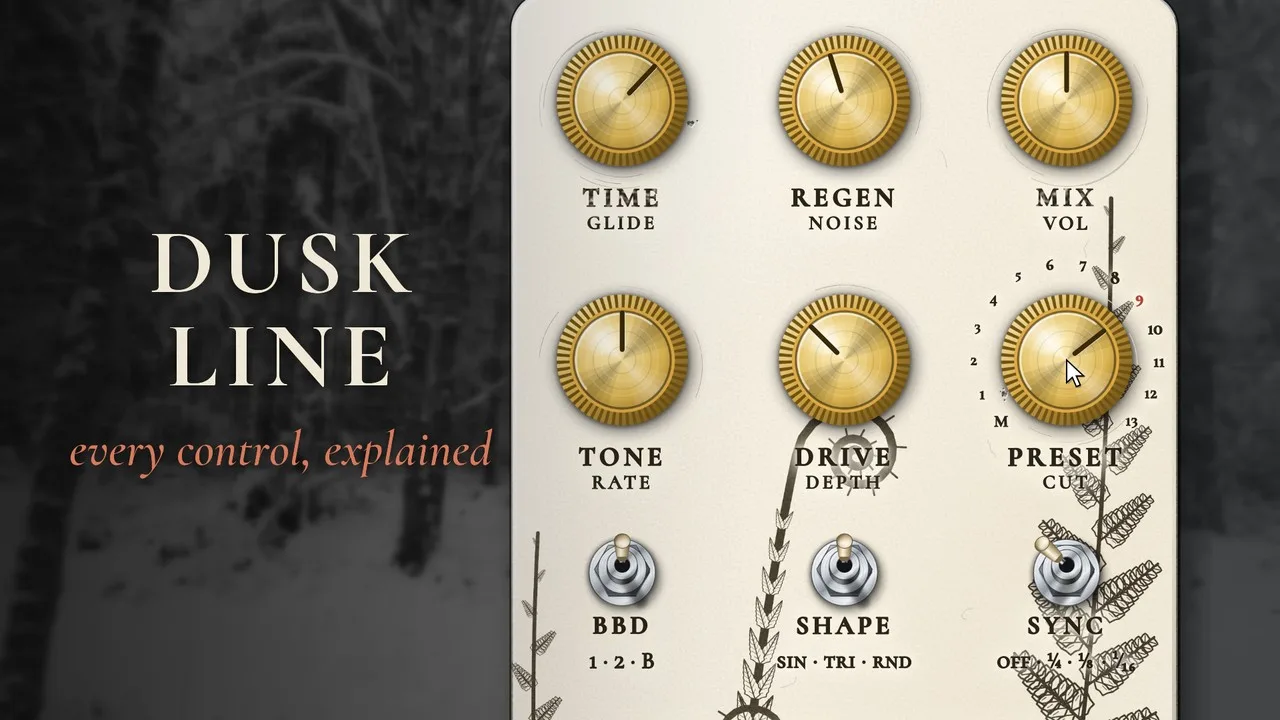
The video manual: 23 chapters, each from the dry sound to the delay set to show one control.
ControlsSix knobs, twelve functions
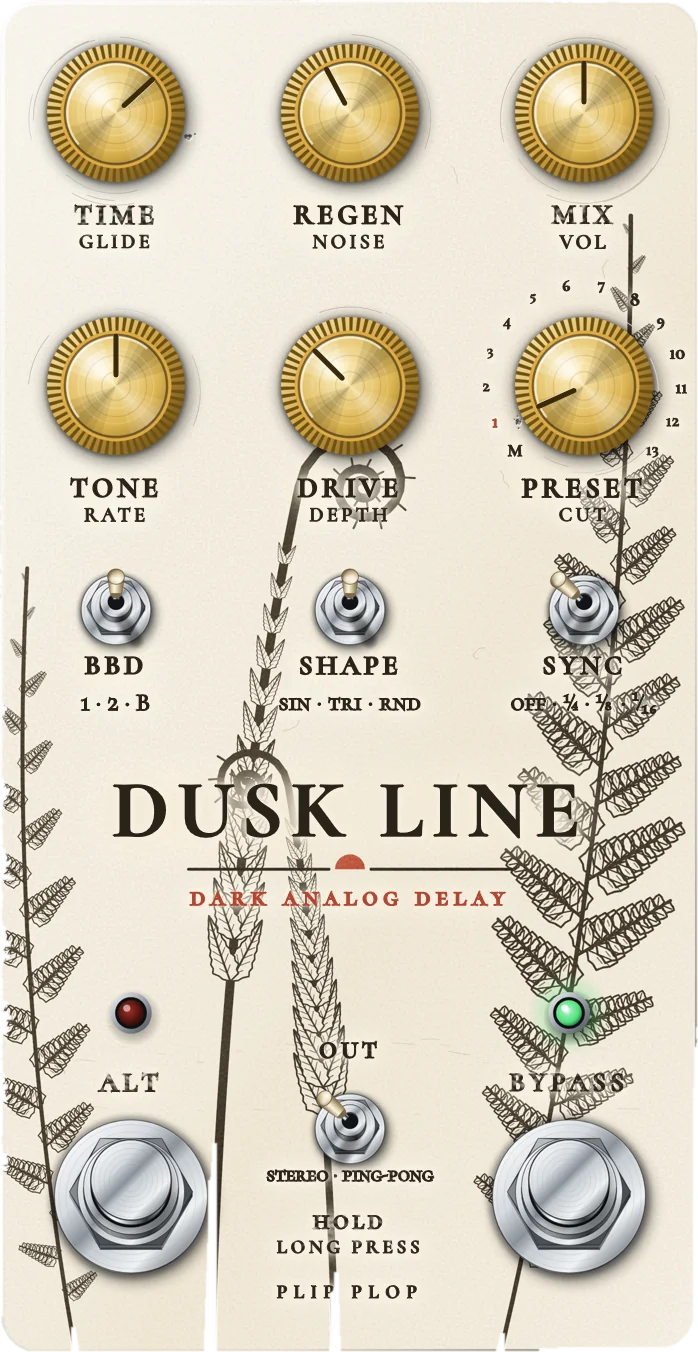
Every knob has two functions. The big label is the main one, the small label under it the alternative: tap ALT and the labels swap places. Drag a knob up or down (hold Shift for fine moves), double-click to reset it.
| Knob | Function | With ALT |
|---|---|---|
| TIME | Delay time from 20 ms to 1.2 s. It changes the BBD clock, so the repeats warp in pitch on the fly. | GLIDE — how fast the clock follows a change of time: from an instant jump to a slow swoop. |
| REGEN | Feedback. 100% is the edge of self-oscillation; the scale goes up to 150%. | NOISE — chip hiss and clock leak, breathing through the compander. |
| MIX | 0% is dry, 50% dry and echo both at full level, 100% echo only. | VOL — output level. |
| TONE | Low-pass filter inside the loop: each repeat comes back darker. | RATE — modulation speed, 0.05 to 10 Hz. |
| DRIVE | How hard the chips are driven: more means stronger saturation in the repeats, with the level kept even. | DEPTH — modulation depth, from a few cents to ±3 semitones. |
| PRESET | M plays straight from the knobs, 1–13 are presets. The knobs glide to a preset in 0.65 s, and going back to M restores your own settings. | CUT — a steep 8th-order low-pass on the echo output, like an amp and cab. Fully up, it is off. |
Toggle switches
BBD 1 · 2 · B — one chip means a slower clock, darker, grittier and more lo-fi; B plays both chips at once, the short and the long delay together, for a dense, washed sound. SHAPE sin · tri · rnd — the modulation shape. SYNC off · ¼ · ⅛ · ¹⁄₁₆ — time from the project tempo; with ALT, dotted notes. OUT stereo · ping-pong — in ping-pong the repeats bounce between channels.
Footswitches
ALT — a tap switches the knobs to their second functions. Hold it for HOLD: the echo self-oscillates for as long as you hold, and the red lamp lights. BYPASS turns the effect on and off; the green lamp shows it is playing.
Window
Resize the window by dragging its bottom-right corner, from 258 to 620 pixels wide; the size is saved with the project. Hover the logo to see every knob's current value, click it to open the manual inside the plugin.
MIDIPlay it from a controller
Right-click any knob, lever or footswitch and choose Learn: the plugin remembers the first controller you move. Assignments are saved with the project.
Footswitches respond like buttons: a value of 64 or more is a press, so a momentary button on your controller gives HOLD for as long as you hold it. Program change 0 selects M, 1–13 the presets.
All 17 parameters, Hold and Bypass included, can be automated from your DAW.
VST is a trademark of Steinberg Media Technologies GmbH.
Measurements
How we measured the chip
Before writing the DSP we put a hardware bucket-brigade delay on the bench: two 4096-stage BBD chips in series, with test tones, sweeps and noise bursts through an audio interface. These are the measurements Dusk Line was built from.
The clock sets the time
Hardware Delay is 4096 clock ticks plus 0.78 ms of filters, at every knob position we measured: two 4096-stage chips in series.
Dusk Line The first repeat lands exactly 4096 clock ticks later (2048 on one chip), whatever the time.
Saturation
Hardware Distortion of the first repeat grows from 0.28 % at −42 dBFS to 12 % at −12 dBFS: soft and even, then harder.
Dusk Line 4.2 / 7.3 / 11.7 % at −18 / −12 / −6 dBFS on two chips, mostly the third harmonic; one chip adds a strong second.
Each pass is darker
Hardware Three repeats of a noise burst: every pass takes 18–19 dB from 2.4–3.6 kHz and 9–10 dB from the lows.
Dusk Line The spectral centre of successive repeats falls 1130 → 870 → 830 Hz, and quiet tails thin out from the bass up.
Clocked sampling folds high notes
Hardware At a 7.6 kHz clock, tones above half the clock come back folded below it, 40–56 dB down.
Dusk Line The line is sampled at the clock rate, so long times fold high notes the same way.
REGEN
Hardware Loss per repeat runs from −23 to −0.6 dB, mostly in the top quarter of the knob; self-oscillation starts between 120 and 127.
Dusk Line REGEN 100 % is the edge of self-oscillation; past it the loop grows into a limiter.